21 December 2020 · Greenwich
The closest conjunction in 397 years — and almost nobody looked up
Jupiter and Saturn came within six arcminutes: a fifth of the width of the Moon. The previous one this tight was in 1623, and nobody saw that one either — for a different reason.
Jupiter goes round the Sun in twelve years, Saturn in twenty-nine. That is why they catch up with each other roughly every twenty years. Coming almost edge to edge is far rarer — and that evening they stood so close that to the naked eye they merged into a single star.
the chart of that minute · Greenwich
- ASC Ascendant♌ Leo 0°46′
- ☉ Sun♑ Capricorn 0°21′house 5
- ☽ Moon♓ Pisces 27°52′house 8
- ☿ Mercury♑ Capricorn 1°17′house 6
- ♀ Venus♐ Sagittarius 7°37′house 5
- ♂ Mars♈ Aries 23°14′house 9
- ♃ Jupiter♒ Aquarius 0°29′house 6
- ♄ Saturn♒ Aquarius 0°32′house 6
Two different distances, and that is not an error
Our computation gives a longitude gap of three arcminutes, while the visible distance was six. There is no contradiction: longitude is position along the zodiac circle, and the two bodies also stood at different heights above the plane of the ecliptic. Astrology counts longitude; the eye sees both distances at once.
Why nobody saw the 1623 one
It was closer then — about five arcminutes. But Jupiter stood thirteen degrees from the Sun and drowned in evening twilight. The last conjunction that was both this tight and comfortably observable falls in 1226.
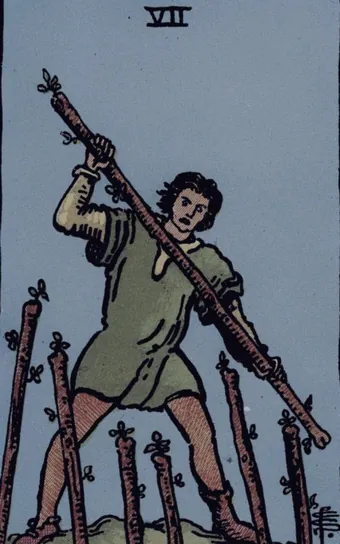
the card of that day
W·VII · Seven of Wands
Your position is worth defending — stand softly but firmly.
How this reads
The Seven of Wands is holding your ground while pressure comes from every side. A fitting card for December 2020, when the world was into its third straight season of holding on to what it had left. The conjunction landed on the zero degrees of Aquarius — astrologers call such a crossing a change of era, and that is what got retold most that year.
The next one this close is 15 March 2080, and that one will be visible.
And what was the sky at your minute
The same computation works for the date and time you were born. The first three readings are free, no account needed.